


How Do Solar Panels Work? A Simple 4-Step Guide
You’ve probably heard that solar panels are a great source of renewable energy, but have you ever actually wondered how do solar panels work?
The science is simpler than you might think. Here’s how a solar panel system turns daylight into electricity for your home, in four easy steps.
–
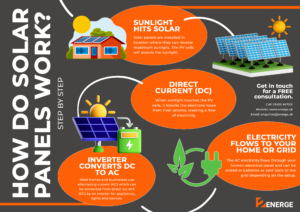
1. Sunlight Hits the Solar Panels
Solar panels are installed where they can capture as much daylight as possible. In the UK, a south-facing roof is the most effective, but east- and west-facing roofs also perform well. Each panel is made up of many photovoltaic (PV) cells, which absorb energy from the sun’s light. Panels don’t need direct sunshine to work, so they still generate electricity on cloudy days, just at a reduced rate.
–
2. Electrons Spring Free
When sunlight hits the PV cells, it knocks electrons loose from their atoms. The cells are built so that these electrons are pushed to flow in one direction, creating an electric current inside the panel.
–
3. The Inverter Converts DC to AC
The electricity the panels produce is direct current (DC), which flows in one direction. Your home runs on alternating current (AC), so an inverter converts the DC into AC, making it safe to use for your lights, appliances and devices.
–
4. Electricity Flows to Your Home or the Grid
Once converted, the electricity flows through your consumer unit (fuse box) to power your home. Any extra can be stored in a battery for later, or exported to the grid. With a Smart Export Guarantee tariff, your energy supplier pays you for the electricity you send back.
–
Thinking About Going Solar?
Now you know how it works, the next step is finding a system that suits your home. Get in touch with Energe and our team will talk you through your options, including solar panels and battery storage.
Check out our info-graphic below:
how do solar panels work